
 Melky
Melky 
The Pre-Judgment funnel: Engineering bias at the query level
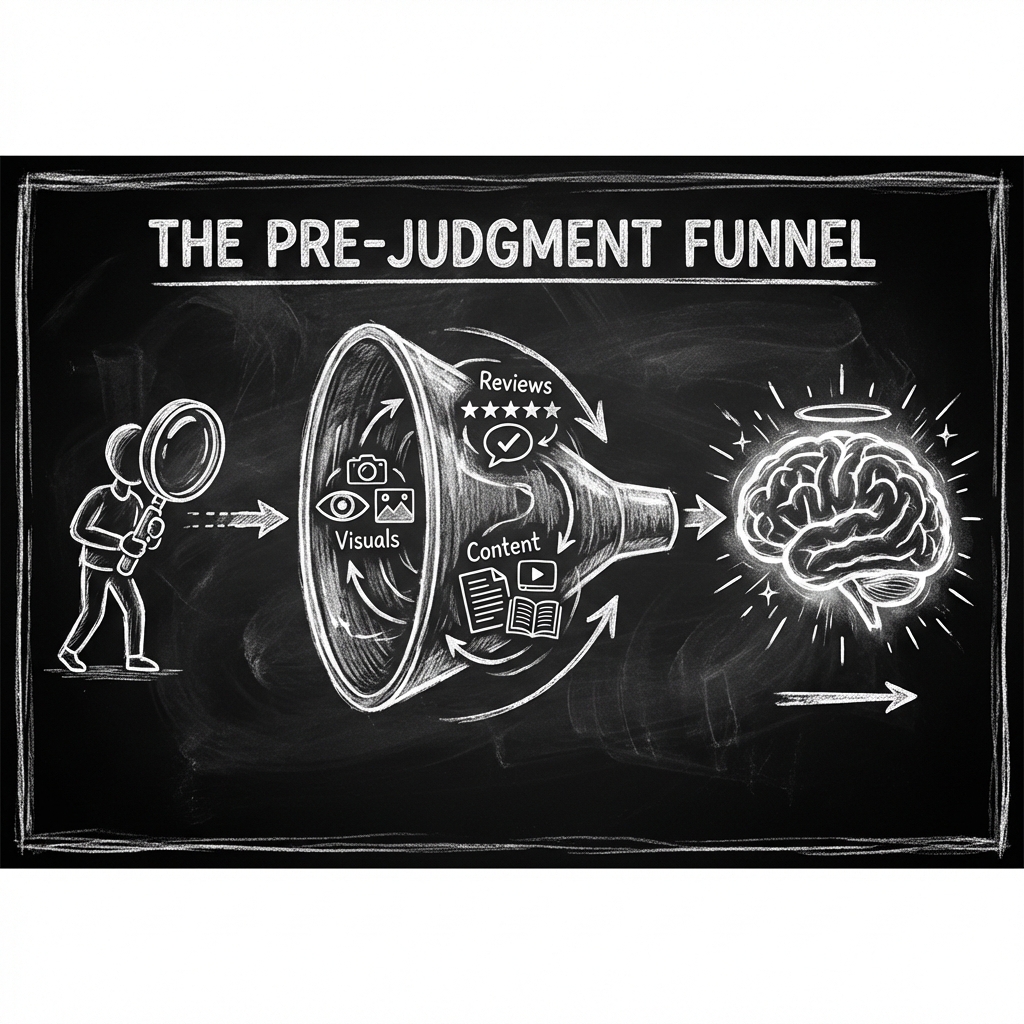
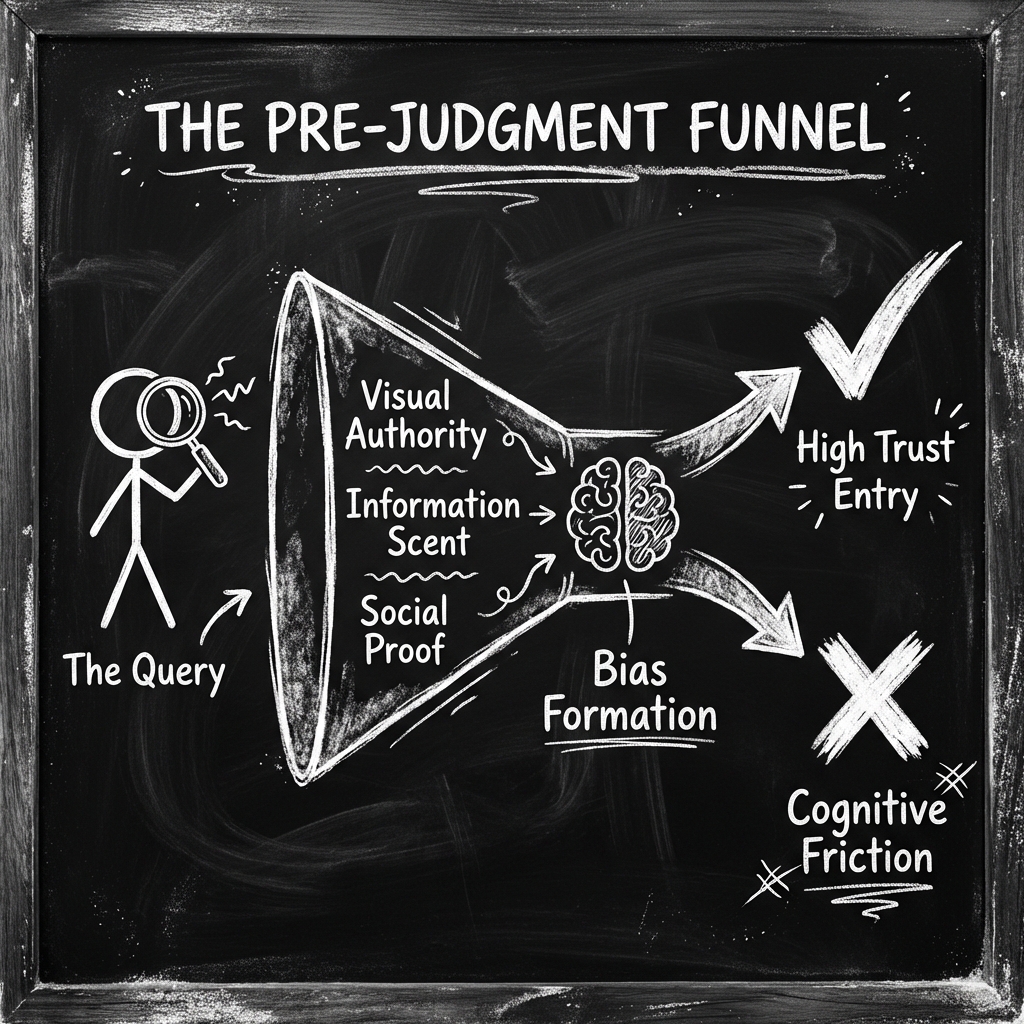
The Pre-Judgment Funnel is the psychological phase of the user journey that occurs between the search query and the first click.
In this critical window, users (and AI agents) assess Visual Authority, Information Scent, and Social Proof to form a bias.
The funnel begins when intent is formed, not when the analytics session starts.
The Conversion Fallacy: Why perfect landings fail
Most teams obsess over “conversion rate optimization” (CRO) on the landing page, yet they ignore the State of Entry.
They hit a wall, and don’t understand why their perfect landing page fails to convert. That wall is a strategic blind spot.
If a user enters your site carrying cognitive friction, born from a messy SERP result, a slow load time, or a vague description, they are primed to reject you.
The Conversion Fallacy emerges when the landing page roadmap excludes the people who work in direct contact with user intent: SEO, Growth, and PPC specialists.
These teams are often invited only after the page is built, reduced to “traffic drivers” when they should be architects of the user’s State of Entry.
When UX/UI writers craft copy in isolation, they optimize for elegance on the page but ignore the promise made in the SERP.
The result is a beautiful landing page that fails to convert because the user arrives carrying unaddressed cognitive friction.
The Integration Principle:
To eliminate this fallacy, you must unify SEO, UX, PPC, and CRO into a single strategic function.
The copywriting, the headline, the visual hierarchy, and the call-to-action must be conceived as one continuous experience, not a handoff between siloed departments.
A user entering with doubt converts significantly lower than a user entering with confidence, even if the landing page is identical.
You must stop optimizing for the action and start optimizing for the feeling that precedes it.
To engineer this feeling, you must first orchestrate the visual landscape where the judgment actually happens.
The SERP as real estate: Visual eminence and schema confidence
The Search Engine Results Page (SERP) is a reputation marketplace, not a directory.
Visual Tone: A result featuring rich snippets (Gold Stars, Pricing, Availability) signals “market leader.” A plain blue link signals “generic commodity.”
The Mechanism: If you use schema markup wisely to own the pixel space, you compel the user to pre-judge you as the safest option.
The user who clicks a “rich result” enters your ecosystem with high trust, primed to buy. This effectively creates visual eminence over your competitors.
But visual eminence is fragile if the underlying sentiment is toxic. You must fortify your position.
The Reputation moat: Why brands pay for silence
Online Reputation Management (ORM) is often dismissed as “vanity PR.” In reality, it is the sophisticated defense of your State of Entry.
Why do strategic leaders invest thousands to suppress a single negative Reddit thread or scrub a 1-star review?
It is not about ego; it is about Pre-Judgment Physics. If a user googles your brand and the Autocomplete suggests “scam” or “complaints,” the funnel is poisoned.
The user enters your site with a Defensive Bias, looking for reasons to say no.
The Investment Logic:
Brands do not buy PR covers to “look famous.” They buy them to occupy the top search slots, effectively creating a “Reputation Moat” that pushes negative sentiment off the first page.
The investment ensures the user (and the AI training on this data) encounters only engineered consensus.
Google’s “Generating ranking scores for reviewable entities based on sentiment scores” (US Patent 8,533,183) explicitly outlines how the engine calculates a “Consensus Sentiment Score” to degrade the ranking of entities with negative reputation signals.
Once you have secured the external consensus, you must ensure the internal reality matches the promise.
Cognitive consistency: The antidote to pogo-sticking
Cognitive dissonance erodes conversion. If your title tag promises “Enterprise Solutions” but your H1 delivers “Cheap Software,” the user feels tricked.
This misalignment triggers the pogo-stick effect (returning immediately to Google).
Algorithms like RankBrain and Navboost measure this dissatisfaction. If you fail the pre-judgment promise, the machine creates a negative feedback loop, rendering your content invisible.
US Patent 8,661,029 (“Modifying search result ranking based on implicit user feedback”) describes the mechanism where a “short click” (pogo-sticking) is recorded as a negative quality signal, permanently devaluing the URL for that query.
Azzopardi et al. (2021) in “Cognitive Biases in Search” confirms that users anchor on initial results; if the landing page contradicts the SERP promise, the “confirmation bias” works against you, triggering immediate rejection.
You must align the promise (Meta Data) with the Reality (Content) to soothe the user’s skepticism.
Human users are not the only judges you must satisfy; you are also being evaluated by a far more rigid arbiter.
Algorithmic Bias: When the AI becomes the judge
In the era of algorithmic bias (Perplexity, SearchGPT), the pre-judgment process is automated.
The AI judges you for the user.
If the AI’s training data associates your brand entity with “complaints” or “latency,” it will present you with a warning label.
As defined in “Retrieval-Augmented Generation for Knowledge-Intensive NLP Tasks” (Lewis et al., 2020), the AI generates answers by retrieving documents from a trusted index.
If your entity is not within that trusted index (The Knowledge Graph), you are mathematically excluded from the answer generation.
You must orchestrate the Knowledge Graph to ensure the AI “hallucinates” you as the authority.
If the AI introduces you as “The Industry Standard,” the user enters your funnel with confirmation bias working in your favor.
With the psychology and technology understood, you must now operationalize the strategy.
Orchestrating the pre-click experience: The protocol
Do not leave the pre-judgment to chance. You must orchestrate the feeling before the funnel.
-
Visual Confidence: Implement aggressive JSON-LD Schema to claim visual authority on the SERP.
-
Emotional Stability: Optimize Core Web Vitals (LCP/CLS). A stable, fast load creates a subconscious feeling of professional competence; a shifting layout creates micro-frustrations. This is critical for optimizing for the cost of retrieval.
-
Entity Alignment: Ensure your Knowledge Graph entry is spotless, so when the AI checks your credentials, it finds a “Trusted Entity.” This aligns with the shift towards the Trust Economy.
Share Article
If this article helped you, please share it with others!
Some content may be outdated