
 Melky
Melky 
From Retrieval to Generation: The Full Story Behind Google's AI-Powered Search and What It Means for Your Content

The Ground is Shifting…Again.
In SEO and digital marketing, change is the only constant. But the shift happening right now is not just another algorithm update; it’s a fundamental rewiring of how Google perceives information.
The engine is moving from a simple keyword-matching system to one that deeply understands user intent in all its facets. This evolution is happening on two fronts: first, in how Google finds relevant information (retrieval), and second, in how it uses that information to generate answers (generation).
This post breaks down the foundational research driving this change, including insights from Google’s own internal presentations.
This builds on the concepts introduced in “The Anatomy of AI Search”
I will try to explore the complete journey from a user’s query to Google’s AI-generated response and, most importantly, provide a clear, actionable framework for creating content that can win in this new era.
The Foundation - Understanding “Multi-Aspect” Thinking
Years ago, a groundbreaking Google research paper co-authored by Michael Bendersky, a key figure in Google’s research division, introduced a concept called “Multi-Aspect Dense Retrieval.”
The idea was simple but profound: a single search query is not a single intent. It’s a collection of potential needs, questions, and facets.
Think of the query “Breville juicer.” A traditional search model might see this as one general concept. But the multi-aspect approach understands this query as a bundle of different possible intentions:
-
eCommerce Intent: The user might be looking for the best price or a place to buy.
-
Informational Intent: They could be wondering about its ease of use, particularly how to clean it.
-
Comparison Intent: They may want to know how its material or size compares to other brands.
A single, “average” understanding of the query would likely miss the user’s specific, nuanced need. The multi-aspect model allows Google’s engine to hold all these potential meanings at once, creating a much richer and more accurate picture of the user’s goal.
The Evolution - From Theory to Reality with MUVERA
That multi-aspect approach was just the beginning. The next evolution, known as MUVERA (Multi-Vector Retrieval via Fixed Dimensional Encodings), applied this same thinking to the documents themselves; your web pages.
This is the breakthrough moment for marketers. Google now analyzes your content for these multiple facets, just as it does for queries.
A single product page is no longer just about the product name; it’s about its features, its benefits, the problems it solves, the audience it serves, and its relationship to other products.
Crucially, MUVERA makes this incredibly complex matching process as fast and cost-effective as older, simpler methods. This efficiency is what allowed Google to deploy it at a massive scale.
It’s a key reason why you now see Google Search Console emphasizing “Trends and Topics” over simple “Queries.” Google is signaling that it no longer just matches keywords; it rewards sites that demonstrate comprehensive authority on a topic in all its facets.
Learn more about how Google processes queries in our detailed breakdown.
The Generative Engine - How Google Creates AI Overviews
Understanding queries and documents with more nuance is how Google finds your content. But how does it use that content to create the AI Overviews we now see at the top of search results?
A new presentation from Google, also co-authored by Michael Bendersky, peels back the curtain on this process.
The core challenge comes down to two competing methods:
-
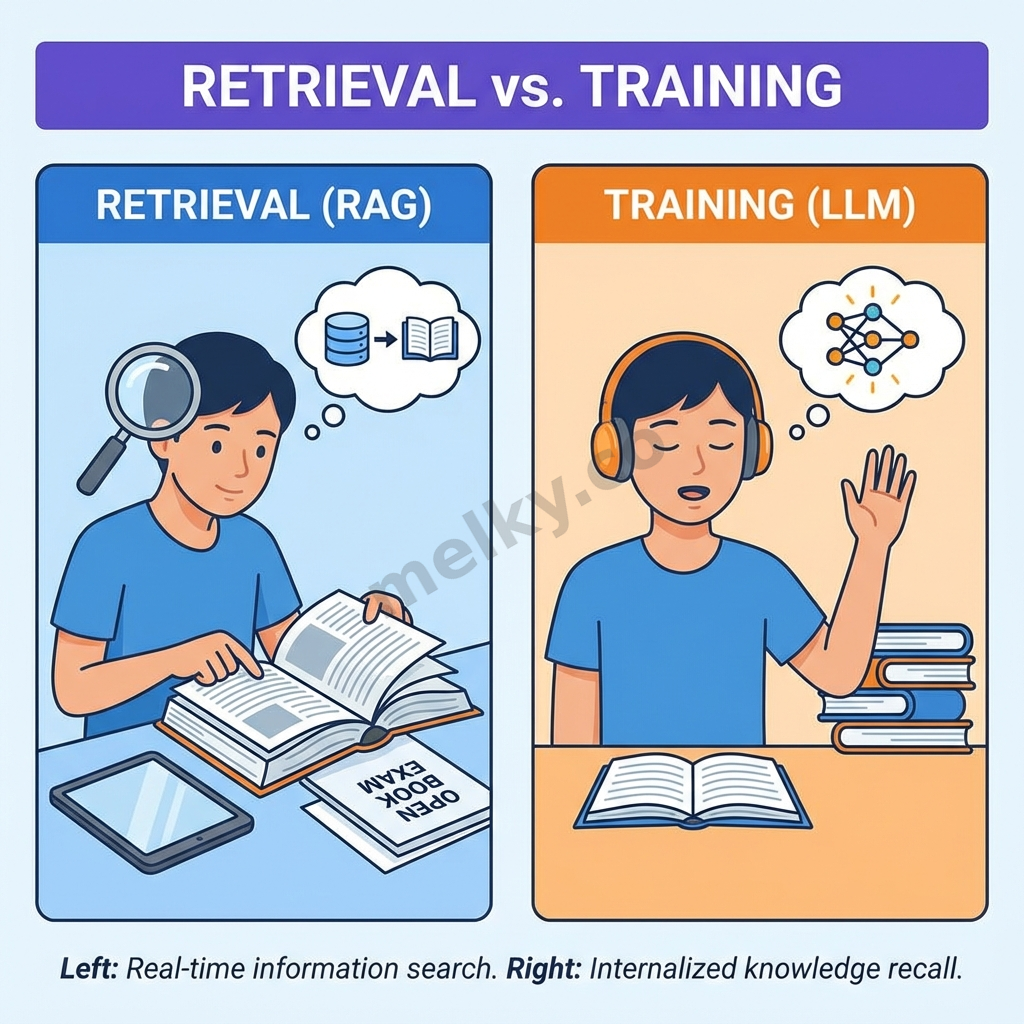
RAG (Retrieval Augmented Generation): Think of this as an “open-book exam.” The system first retrieves a handful of what it believes are the most relevant snippets of text from the web. It then generates an answer based only on those snippets. It’s fast, efficient, and great for straightforward questions.
-
Long-Context (LC): This is like giving the AI the entire textbook. The system takes all the potentially relevant documents and feeds them into a massive context window (like Gemini 1.5 Pro’s). It then reads and synthesizes an answer from the entire body of information. This is incredibly powerful and can answer complex questions, but it’s much slower and more expensive.
You may ask yourself, ok Myriam, what you’re saying is correct, but which one does Google use? It uses both, in a clever hybrid model called “Self-Route.”
The system first tries the fast and cheap RAG approach. The AI itself determines if it can answer the query with the snippets it found. If the query is too complex, general, or implicit for the snippets to make sense, the system escalates and uses the more powerful (and expensive) LC method.
This hybrid approach gives Google the best of both worlds: the power of deep understanding when needed, at a cost that can be managed at a global scale.
Actionable Strategies for the Hybrid Era
Understanding this RAG/LC hybrid model is the key to unlocking your content’s potential. Your strategy must now be two-pronged: make your content easy for the RAG retriever to grab, but also rich enough for the LC synthesizer to work with.
Strategy 1: Be RAG-Friendly (The Foundation)
This is about making your content easily digestible. The RAG system loves clean, well-structured information that it can pull out as a “snippet.”
- Actionable Tip: Use clear, descriptive headings (H2s, H3s) that ask and answer specific questions. Employ bullet points, numbered lists, and tools like schema markup to structure your data. This makes individual facts and answers easy for Google to retrieve and is the baseline for performing in the new model.
Strategy 2: Be LC-Ready (The Differentiator)
This is where you gain a true competitive edge. The goal here is to create content that solves the exact problems where RAG fails. According to Google’s research, RAG struggles when a query is:
Multi-step: Requiring one fact to understand the next.
General: Too broad for a single snippet to answer.
Complex: Containing many constraints and details.
Implicit: Requiring the connection of different “dots” to deduce an answer.
Actionable Tip: Don’t just state facts; connect them. Instead of just listing product features, write a paragraph explaining how those features combine to benefit a specific type of user. Don’t just define a concept; create a table comparing it to a related concept. Create content that builds a logical argument or a narrative, allowing the AI (and your users) to deduce answers to questions that aren’t explicitly spelled out in a single sentence.
Build for Topical Authority and Synthesis
Tie it all together. The ultimate goal is to build a dense, interconnected hub of content around a core topic.
Your site architecture should link supporting articles to pillar pages, creating a web of information that is both broad and deep. This structure serves both of Google’s needs: the individual pages are RAG-friendly snippets, while the entire hub provides the rich, comprehensive information needed for LC synthesis.
Conclusion: The New Currency of Relevance
The future of SEO lies beyond keywords and simple relevance. To succeed, we must create content that serves a dual purpose. It must be structured and clear for quick, efficient retrieval, but also deep, interconnected, and insightful enough to fuel sophisticated AI generation.
The marketers who thrive will be those who stop chasing single keywords and start building true topical authority.
By creating content that is both easily found and deeply insightful, you provide the perfect raw material for Google’s new hybrid engine and establish your brand as a definitive resource in an AI-powered world.
Share Article
If this article helped you, please share it with others!
Some content may be outdated