
 Melky
Melky 
The resilient SEO: Applying Google’s core principles in a post-AI world

Over the course of this series, we have journeyed through two decades of Google patents, guided by the insights from Koray Gübür.
We’ve seen how “new” concepts like semantic search, query refinements, and entity understanding are not new at all, but are the modern expressions of a vision laid out at the dawn of the 21st century.
We’ve deconstructed the engine.
We’ve examined the blueprint.
Now, we arrive at the most important question:
What do we do with this knowledge?
Chasing the latest algorithm update or buzzword is a reactive, fragile strategy.
It leaves you perpetually catching up.
But understanding the core, unchanging principles of how a search engine works allows you to build a resilient, proactive, and future-proof strategy. For a practical guide to implementing this, see Stay Calm and Do the Work.
“Without understanding the Query Processing in the eyes of the Search Engine, you can’t create the relevant, and satisfying document based on minor and dominant search activity types.”
This final article is about translating that understanding into action. Here is what a truly resilient SEO strategy looks like, built on the foundational principles we’ve explored.
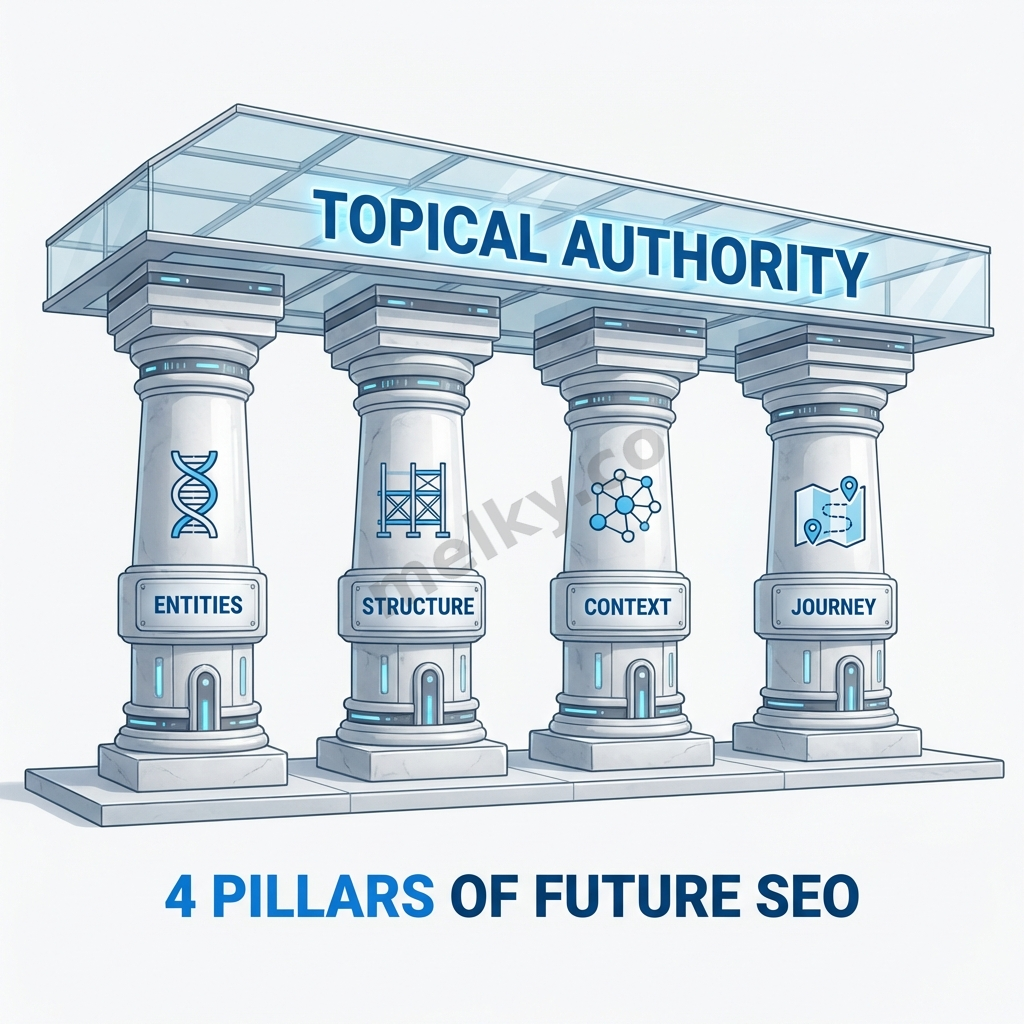
This is the final article in the “AI Search? It’s Just Search, Rebranded” series, synthesizing Koray Gübür’s insights into actionable strategy.
1. Shift from Keywords to Entities and Topics
The patents on Open Information Extraction, Entity-seeking Queries, and the Knowledge Graph’s origins make one thing clear: Google stopped being a keyword-matching engine a long, long time ago.
Actionable strategy:
When creating a content plan, start with the core entity (a person, place, product, concept), not just the primary keyword.
Map out its key attributes (its features, history, relationships, functions) and the topics that surround it.
Use tools to analyze “People Also Ask” and “Related Searches” to reverse-engineer the query clusters Google has already identified.
Your goal is to create a resource that comprehensively covers a topic’s semantic cluster, not just a single search term.
2. Structure your website for a machine audience
Sergey Brin’s first semantic patent was designed to find patterns in HTML to extract facts.
Today, we have a standardized language to give those facts directly: Schema.org.
Actionable Strategy:
Implement robust structured data on your site.
Don’t just use basic Article or WebPage schema.
Go deeper.
Use FAQPage for question-and-answer sections, HowTo for instructional content, and specific schemas like Product, Event, or LocalBusiness.
You are essentially handing your information to Google on a silver platter, perfectly formatted for ingestion into its structured database.
3. Write for Context, Not Just for Humans
The Context-Vectors patent and the rise of models like BERT and MuM prove that context is the ultimate ranking factor.
Google doesn’t just analyze the words on your page; it analyzes their relationships to each other and to the broader contextual domain.
Actionable Strategy:
When writing, be obsessively clear about your context. Mention co-occurring entities that are relevant to your topic.
An article about “Apple” the company should mention “iPhone,” “Tim Cook,” and “Cupertino.” This helps Google’s models place your content in the correct vector space. Use unambiguous language.
Instead of just saying “it,” specify the noun you’re referring to. This aids in entity reconciliation and demonstrates clarity.
4. Answer the Entire User Search Journey, Not a Single Query
The patents for Midpage Query Refinements and Conversational AI models like LaMDA show that Google views search as a multi-step journey, not a one-off transaction.
Actionable Strategy:
Structure your content to answer a sequence of questions.
Anticipate the user’s next step.
If they are learning “what is a mortgage,” their next question will likely be “how to apply for a mortgage” or “types of mortgages.”
Create comprehensive guides that walk the user through the entire journey. This positions your website not just as an answer, but as a guide, making it invaluable for both users and the algorithms designed to map their paths.
The End of Chasing Ghosts
It starts by applying these core principles: dramatic, sustainable organic growth achieved by building web pages for an entity-oriented, semantic search engine.
When you understand the fundamentals, you stop chasing algorithm updates.
A “Helpful Content Update” is no longer a mystery; it’s a logical extension of the patent that warns against “overly broad pages” with “discordant queries.”
An update focused on “experience” and “authority” is the natural evolution of a system built to weigh and reconcile facts from trusted sources.
You will no longer be surprised. You will see it coming.
And that is the most powerful and resilient position an SEO can be in.
Share Article
If this article helped you, please share it with others!
Some content may be outdated