
 Melky
Melky 
You are no longer optimizing a website: The shift to web entities
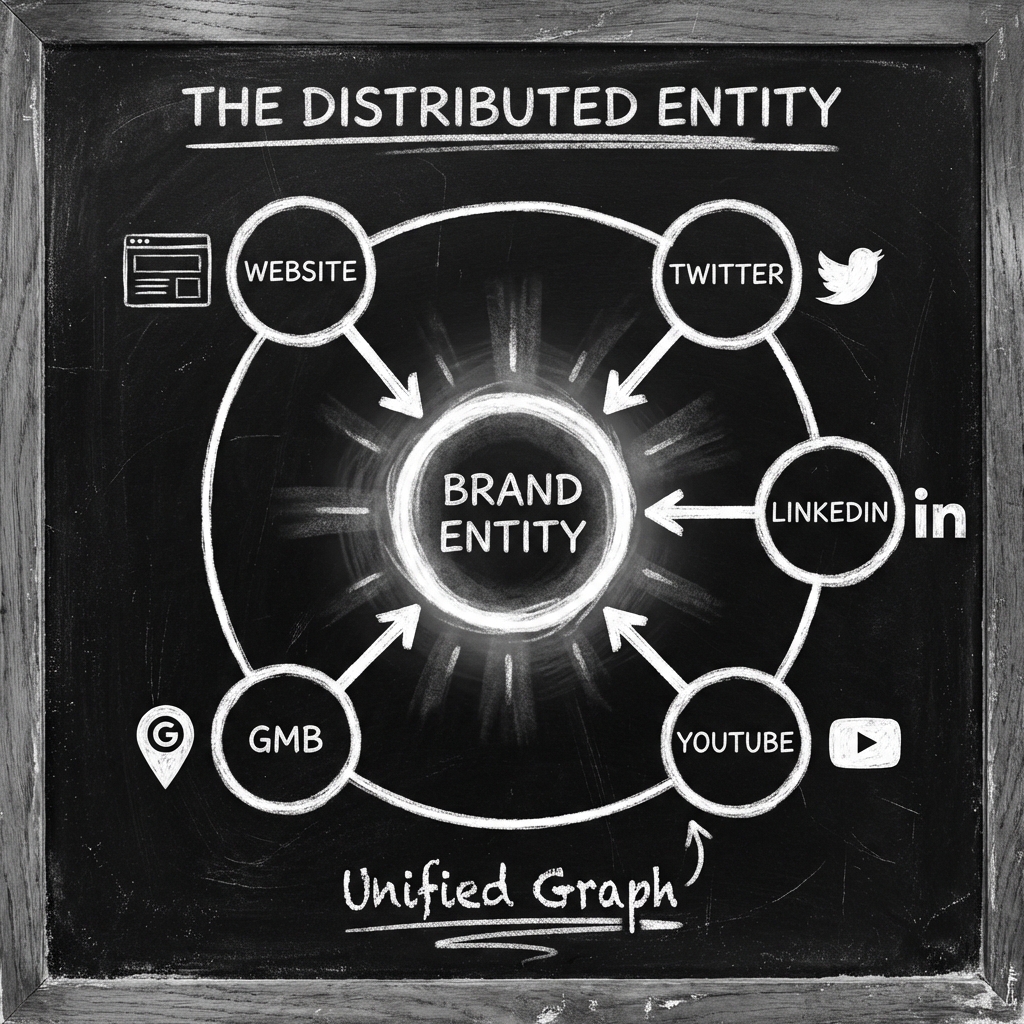
The distinction between a “website” and a “web entity” is no longer theoretical.
On December 8, 2025, Google made an announcement that fundamentally alters how we must view search performance
They introduced social channels directly into Search Console, offering site owners a “unified view” of their Google Search performance across both their websites and their social profiles.
This move confirms what semantic SEO experts have argued for years. The search engine is not ranking a domain. It is ranking an entity.
The evolution of the entity
The integration of social metrics into the primary dashboard for webmasters is not a random feature update. It is the final step in a clear schematic evolution of how Google understands brands.
- Knowledge Panels: Google first connected disparate social profiles to a central entity card, proving it understood the relationship between
brand.comandx.com/brand. - Google Business Profiles: These profiles were then tightly integrated with local panels, merging physical location data with digital footprint data.
- Search Console: Now, the data is unified.
The patent blueprint
Google search engine updates often happen after a published patent. This specific update appears to be the practical realization of US Patent 20130297593A1: “Author authority in social media.”
This patent explicitly describes a system for ranking authors based on their influence within a social graph, independent of their website’s link profile.
Key components of this patent include:
- Social graph weighting: Assigning value to content based on the author’s connectedness on social platforms.
- Influence scoring: Measuring how far an entity’s content travels across the social web (repost, shares, comments).
- Entity reconciliation: The process of matching a social profile (e.g.,
@yourbrandhandle) to a canonical entity (e.g.,yourbrand.com).
For years, this patent was theoretical and considered among SEOs as a “pipe dream”. With the integration of “Social Channels” into Search Console, we now have the confirmation that Google has solved the “Entity reconciliation” problem at scale.
They can now confidently attribute social signals directly to your web entity.
Google now treats your social profiles as active nodes in your entity’s graph.
They are no longer just external links to be disregarded. They are tracked assets with their own visibility metrics.
The new Search Console Insights report explicitly tracks:
- Total reach: The total clicks and impressions driving traffic from Google to your social channels.
- Content performance: Which of your social posts are trending in search results.
- Search queries: The specific keywords leading users to your social profiles rather than your website.
This data proves that Google is actively indexing and serving your social content to answer user queries directly.
The mechanism: social as a freshness signal
During testing across multiple Google Business Profiles, I observed a critical correlation. Indexed URLs from forum contexts and the web vertical are contributing directly to stronger Map Pack rankings.
This mechanism reveals how Google uses social platforms. They function as high-frequency sensors for “freshness.”
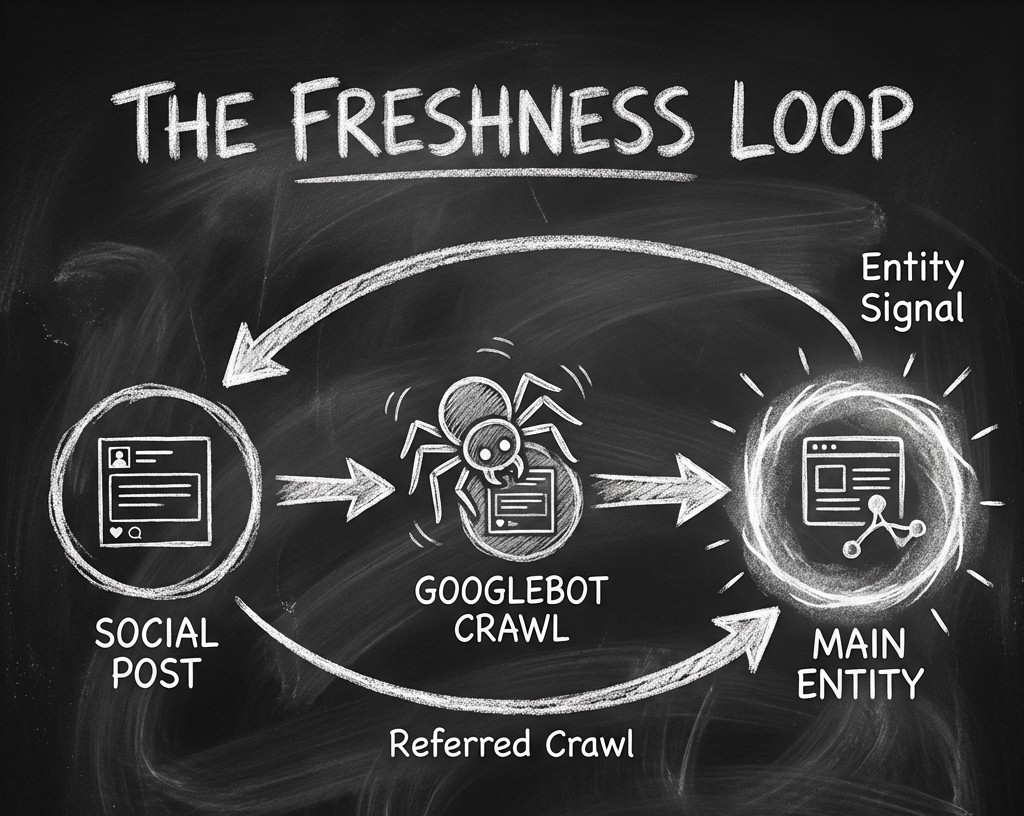
A corporate website is often static. It changes weekly or monthly. Social channels change hourly. Google uses this high-frequency data to verify that an entity is active, alive, and relevant.
If you do not post consistently, you stay invisible to this layer of the knowledge graph.
If you post regularly, you earn “Social Updates” visibility under your brand name in the SERP.
The invisible index
This leads to a simple but uncomfortable truth. If you treat SEO as a discipline isolated to your root domain, you are optimizing for a version of Google that no longer exists.
Log file analysis frequently shows Googlebot crawling patterns that originate from social referrers. The crawler follows the buzz. When an entity is active on social media, it triggers crawl activity on the main domain.
These “referred crawls” are a distinct signal. They tell the engine that the entity is generating interest in the real world.
Actionable strategy: Break the organizational silos
The barrier to “Distributed Entity” optimization is not technical. It is organizational.
In most companies, the Social Media team sits in one room (chasing engagement), the Product team sits in another (building features), and the SEO team is brought in at the end to “optimize” the landing page.
This siloed approach ensures failure in the age of semantic search.
To optimize an entity, you must stop asking for permission and start embodying the role of a data-driven strategist.
You must speak in decision units, not keywords.
1. Move SEO upstream to product creation
The SEO team typically has the best understanding of the customer’s questions (intent). The Social team understands the customer’s conversations (sentiment). The Product team builds the solution.
If these three insights only meet at launch day, you have lost.
SEOs must integrate into the product roadmap phase. Your goal is not to “find keywords for the product,” but to ensure the product itself answers a validated market intent.
2. The “Pre-Signal” workflow
Stop launching pages into a void. Use social channels to validate the entity before the URL exists.
- Old Way: Build Product -> Publish Page -> Share on Social.
- Entity Way: Tease on Social (Signal) -> Capture Search Demand -> Publish Page (Satisfaction).
By the time your page goes live, the entity should already be “hot” in the Knowledge Graph.
3. The unified KPI: Entity Visibility
Stop reporting “Organic Traffic” and “Social Reach” as separate metrics to leadership. They are two sides of the same coin.
Report Entity Visibility: The sum of all touchpoints where your brand answers the user’s need. Whether they click your LinkedIn post or your Google snippet, the entity has won.
SEO is no longer isolated to your domain. It is distributed across your entire digital identity.
Share Article
If this article helped you, please share it with others!