
 Melky
Melky 
How Google really understands your search: Beyond just keywords

For years, the mantra has been drilled into us: “Find the keyword, write content for the keyword.” You spend hours in keyword research tools, identify a term with decent volume and manageable difficulty, and then craft a piece meticulously designed to rank for that specific phrase.
Sound familiar?
We’ve all been there. It’s the foundational SEO we learned. And for a while, it worked pretty well.
But here’s the revelation, if you haven’t fully embraced it yet: Every Google core update moved far beyond that simple keyword-matching game.
The search engine of today is less like a literal-minded librarian fetching an exact title and more like a seasoned detective, a brilliant chef, or an intuitive personal assistant.
This post will demystify how Google truly understands your search queries and how you can adapt your SEO strategy.
This is part of the series “AI Search? It’s Just Search, Rebranded”
The foundational shift: “Raw Query” vs. “Processed Query”
Imagine walking into a high-end restaurant and vaguely telling the chef, “I want something good.” A novice chef might freeze, unsure of what to do.
But an experienced chef? They’d start processing: “Is this for a special occasion? Do they prefer savory or sweet? Light or hearty? Any allergies? What’s fresh today that fits a general ‘good’ experience?”
Search engines now act like that experienced chef.
They were novice chefs years ago; every update refined their approach and improved their experiences.
-
Raw Query: This is what the user types into the search bar. It’s the literal string of words.
- Example: “best shoes”
-
Processed Query: This is Google’s internal, enriched understanding of the raw query. Google’s algorithms analyze the raw query and augment it with layers of context, intent, and associated concepts to figure out what the user really wants.
- Example (for “best shoes”): Google might interpret this as: “The user is likely looking to purchase athletic footwear, probably for running or general fitness.
They’re seeking reviews, comparisons, information on price points, and potentially specific brands known for quality. They might also be interested in durability, comfort, or style.”
This shift from merely indexing keywords to deeply understanding intent and context is the bedrock of search since search engines become an important growth channel.
Processed query, how is it built?
How does Google build this “processed query”? A key component is understanding Contextual Domains. These are the different semantic areas or knowledge spheres a query might touch upon.
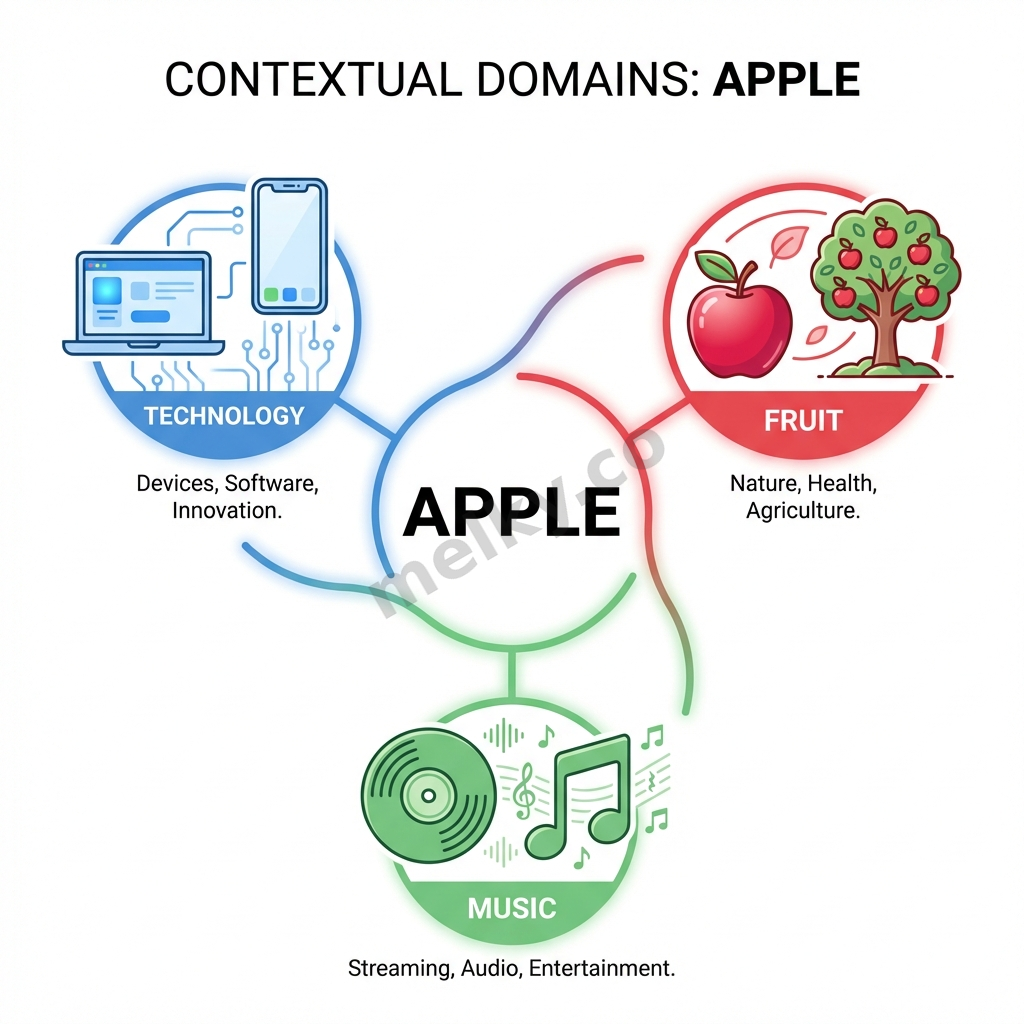
Google’s AI, including sophisticated systems like RankBrain and MUM, considers these domains and prioritizes them based on a multitude of signals:
-
The user’s past search history
-
Their location, current events
-
Global search trends and the overall “authority” of information sources within those domains.
Note: Recent Google tests (e.g., from Google I/O) have shown AI Overviews are effectively sending quality traffic to linked sources. Which means those clicks are more likely to lead to conversions. Contextual domains aren't new, but Google's search algorithm is now really using them to their full potential.Let’s take the example of Koray Tugberk to explain this: “Methylene Blue”
A simple two-word query, but it can unlock vastly different worlds of information. This is a perfect example of how search engines handle ambiguity:
-
Medical/Pharmaceutical Domain:
- Entity Attributes: Uses (methemoglobinemia treatment, diagnostic dye, ifosfamide toxicity), side effects, dosage, contraindications, FDA approval status, chemical structure, mechanism of action.
-
Aquarium/Pet Care Domain:
- Entity Attributes: Use as an anti-fungal/anti-parasitic for fish, dosage for tanks, safety for different species, impact on bio-filters, and product availability.
-
Nootropic/Biohacking Domain (Emerging):
- Entity Attributes: Claimed cognitive benefits, research (often preclinical), user anecdotes, risks, purity concerns, typical (off-label) usage.
-
Industrial/Chemical Domain:
- Entity Attributes: Use as a dye (textiles, labs), redox indicator, manufacturing process, safety data sheets (SDS), and purity grades.
Google doesn’t just see “Methylene Blue.” It sees these potential contextual domains and uses other signals to figure out which one (or which combination) is most relevant to this specific searcher at this specific moment.
Let’s try a more common example: “Apple”
-
Fruit Domain:
- Entity Attributes: Nutritional value, recipes (apple pie, applesauce), types (Granny Smith, Fuji), growing seasons, health benefits, history of cultivation.
-
Technology Company Domain:
- Entity Attributes: Products (iPhone, MacBook, Apple Watch), software (iOS, macOS), stock price (AAPL), CEO, company history, news, upcoming releases, support.
-
Record Label Domain (Apple Corps):
- Entity Attributes: Association with The Beatles, music catalog, history, legal disputes with Apple Inc.
For each domain within its vast index, Google develops an in-depth comprehension of crucial “Entity Attributes”: the properties, characteristics, verifiable facts, and interconnected concepts intrinsically linked to an entity within that specific context.
As Koray Tuğberk GÜBÜR frequently emphasizes, these attributes serve as the foundational building blocks of Google’s understanding.
These are the properties, characteristics, facts, and related concepts intrinsically linked to an entity within that specific context.
Think “uses,” “types,” “benefits,” “side effects,” “history,” “manufacturing steps,” “key people,” “related products,” etc.
These Entity Attributes serve as the foundational building blocks of Google’s understanding, going far beyond simple keyword matching.
They encompass the inherent qualities, distinguishing characteristics, verifiable facts, and interconnected concepts that are organically associated with any particular entity within its specific contextual domain.
Consider this comprehensive list as just a starting point:
-
Uses: How an entity is applied or employed in various scenarios, its practical function, and utility.
-
Types: The different categories, classifications, or variations within the entity, its diverse forms and subtypes.
-
Benefits: The positive advantages, favorable outcomes, or desirable effects associated with the entity, its value proposition.
-
Side Effects: Any unintended or secondary consequences, often applicable in the context of medical or technological entities, and their potential drawbacks.
-
History: The chronological development, background, and evolution of the entity, its origins and journey.
-
Manufacturing Steps: The detailed processes involved in creating or producing the entity, its production cycle, and stages.
-
Key People: The notable individuals or groups associated with the entity, its significant contributors, and stakeholders.
-
Related Products: Other entities that are connected, associated, or complementary to the primary entity, its surrounding ecosystem.
This intricate web of Entity Attributes allows Google to move beyond surface-level keyword analysis.
Instead, it empowers the search engine to grasp the true essence and significance of each entity, providing users with far more relevant and nuanced search results.
Understanding these deeper attributes is important for search algorithms as they can assess not only what words are present on a page but also what concepts are being discussed and how those concepts relate to one another within a given domain.
This comprehensive approach is fundamental to the Search engine’s ability to deliver highly accurate and contextually aware search experiences.
The true nature of Google updates: Refinement, not revolution
Here’s a common misconception that causes a lot of panic in the SEO world: that Google’s algorithm “changes overnight,” “SEO is dead,” or introduces entirely new rules with every core update.
If someone tells you SEO has just been flipped on its head because of the latest Google announcement, they’re likely missing the bigger picture.
As Koray Tuğberk GÜBÜR often points out, Google’s semantic search evolution has been ongoing for over 27 years.
The underlying methodology, which processes raw queries, identifies contextual domains, and understands user intent, hasn’t fundamentally changed.
Instead, what we perceive as “algorithm updates” are Google’s continuous attempts at refinements. The giant algorithm is (trying) to get smarter and better at understanding language, context, and quality in order to serve the users.
It’s becoming more precise in applying those core principles.
Why does this matter to your online presence?
The drastic shifts and “penalties” many websites experience during core updates aren’t arbitrary punishments.
They are often a direct consequence of relying on surface-level SEO tactics. If your strategy was built solely around keyword density, content length for length’s sake, or superficial link building, you were essentially playing a game that Google was constantly evolving past.
Your work was effective for a “novice chef” search engine, but not for the “experienced chef” it has become or is trying to become.
Websites that truly get “hit” by updates are those whose content and technical setup didn’t align with Google’s deeper, semantic understanding.
They were providing generic, easily arbitraged information, not the comprehensive, context-rich pages that search engines are now expertly identifying and rewarding.
Consider the case of a well-known example like GeeksforGeeks.org. While renowned for its deep expertise in computer science and programming, this site experienced significant traffic volatility.
I am an outsider, I will never have the real reason for their traffic impact, but from the outside, we guessed this was partly due to its expansion into numerous topics far outside its core technical macro-context, such as general health, travel, or basic lifestyle advice.They ventured into domains where their established authority and E-E-A-T (Experience, Expertise, Authoritativeness, Trustworthiness) were not as strong, which inadvertently diluted their perceived relevance for their core topics in Google’s increasingly refined semantic understanding.
This was seen as a “way” to game the system.
Conversely, if you approach SEO with the deeper understanding we’re discussing, by focusing on processed queries, contextual domains, and genuinely satisfying user needs, your website becomes inherently more resilient.
You’re building an entity with a clear Macro-context for Google’s core mission, which doesn’t change, only refines.
This long-term, semantic approach allows you to grow steadily over the years, less impacted by the turbulence of update cycles.
Structuring your web pages: “Macro-contexts” and “Micro-contexts”
Okay, Google gets all this.
How do you cash in on this understanding to create pages that search engines, LLMs (and users) will love? By thinking in terms of Macro-contexts and Micro-contexts.
- Macro-context: This is the overarching topic or primary contextual domain your content will focus on.
If you’re writing about “Apple,” you first need to decide: are we talking fruit, tech, or music?
I will assume you choose the tech company.
That’s your macro-context.
Example: Mac rumors macro-context is Apple, the tech company
- Micro-contexts: These are the specific subtopics, questions, entity attributes, and facets within that chosen macrocontext. For “Apple” (tech company), micro-contexts would include:
-
iPhone 17: specs, reviews, price, comparison to previous models.
-
Apple Watch Series 10: features, health tracking, battery life.
-
iOS 19: new features, compatibility, and known issues.
-
Company Financials: quarterly earnings, stock performance.
-
Tim Cook: leadership, biography.
-
Your website, as a whole, often aims to establish authority within one or several core Macro-contexts (like ‘B2B SaaS solutions’ or ‘healthy living’).
To achieve this, every web page you deploy should serve as a dedicated piece that either fully addresses a Micro-context within your chosen Macro-context or acts as a comprehensive ‘pillar’ page for a Macro-context itself.
To truly bulletproof your website’s authority and relevance in Google’s semantic understanding, your goal should be to build a strong website system where each page systematically contributes to covering the diverse Micro-contexts and strengthens your overall authority within your target Macro-contexts.
This systematic approach ensures your website is a robust source for Google’s multi-aspect retrieval system.
Mini-exercise for your next content piece:
When you research a topic, don’t just list keywords.
Ask yourself:
-
What are all the major angles or primary domains from which people approach this topic? (These are your potential Macro-contexts. You’ll likely choose one primary one for a given piece of content, or a very closely related set.)
-
Then, for your chosen Macro-context, what are all the specific questions, features, comparisons, attributes, or details they might be looking for? (These are your Micro-contexts. Your content should aim to cover the relevant ones comprehensively.)
This approach helps you build web pages that aren’t just “keyword-stuffed” but are genuinely comprehensive and satisfy the multiple facets of user intent that Google is trying to understand.
How to check this & adapt your strategy
Understanding this is one thing; putting it into practice is another.
Here’s how to start:
- Keyword research shift:
-
Move beyond just search volume and difficulty. When you identify a target query, ask: What are the likely contextual domains search algorithm (LLM included) associates with this? What’s the underlying intent?
-
Check Google: Look at the “People Also Ask” (PAA) boxes, “Related Searches,” and the nature of the top-ranking SERP features (videos, images, shopping results, knowledge panels). These are direct clues into Google’s processed query and the contextual domains it deems relevant.
-
Now with AI search, like Chagpt, YOU.COM, Claude, Grok, I advise you to look at the autocompletion when you type the first two words of your macro-context to understand more what the search user needs.
The autocompletion in these LLMs is often highly refined, reflecting a deeper understanding of typical user needs and the most common follow-up questions within a macro-context. This provides invaluable insight into what the “search user needs” is beyond the initial few words.
While traditional keyword tools are still useful, we need to use this new type of data source directly from the AI experience, providing a fresh perspective.
- Web structure planning & creation:
-
Use the Macro/Micro-context approach to structure your web pages. From services to company pages. With AI search, every page on your website is a potential high-converting page.
-
For example, you can use your support page to provide incentives for people looking to cancel their subscription to your services. Make it ready to rank for “How to cancel [brand] subscription”.
-
Note: It's often tempting (or a common oversight) not to include your SEO teams during your product creation roadmap. However, this is a significant mistake, as early SEO input ensures discoverability and user alignment from the start.- Create a structure that identifies the primary Macro-context and then list the Micro-contexts (specific questions, entity attributes, subtopics) you need to cover. This ensures comprehensive coverage.
- Copywriting:
- Advise your copywriters (or yourself, Your AI) to explicitly cover the various facets (Micro-contexts) of your chosen Macro-context.
- Focus on clarity, authoritativeness, and helpfulness for each potential angle of inquiry within your topic. Answer questions thoroughly.
- Competitor Analysis:
- When analyzing top-ranking pages, don’t just scrape their keywords. Look at the breadth and depth of contextual domains they cover.
- Which Micro-contexts are they addressing well? Where are the gaps you can fill to provide even more comprehensive value?
Shift your definition of Traffic success
With features like AI Overviews and Google’s increasing ability to directly answer queries, the raw volume of clicks to your site might evolve.
Don’t panic; instead, refocus on click quality.
As Google itself has suggested, clicks from experiences like AI Overviews may be more qualified. Users who click through after seeing a comprehensive AI-generated summary are often further down the funnel or have a more specific, validated need.
This means we are indeed witnessing the end of “blank traffic”, those low-intent clicks that bounce quickly.
Instead, SEO is becoming an even better traffic source for actual conversion because Google’s AI is doing a more effective job of pre-qualifying and funneling more engaged users to your site when your content truly meets their sophisticated, processed query.
The short answer is yes, the nature of SEO traffic is changing. I am curious to see how the future confirms or proves me wrong, but the signals are strong that quality will increasingly trump sheer quantity.
Focus on attracting users (mid-funnel users) who have a genuine, well-defined interest that your comprehensive, context-rich content can satisfy.
The future and present were always contextual
Google’s mission is to organize the world’s information and make it universally accessible and useful. To do that effectively, it must understand language, intent, and context at a near-human level.
When you shift your mindset from “keywords” to “contexts” and “entities,” you’re optimizing for users.
Every page on your website is a potential high-converting page.
Why? When Google’s AI LLM accurately matches nuanced queries to your comprehensive content, the clicks you receive are from users whose intent is already highly refined, leading to greater engagement and conversion potential.
Your web pages that are more helpful, more comprehensive, and ultimately, more likely to be rewarded in the search results and LLM search results.
It’s time to move beyond just keywords and embrace the rich, contextual world of modern search.
Your audience will thank you for it.
Share Article
If this article helped you, please share it with others!
Some content may be outdated