
 Melky
Melky 
The algorithmic brief: From data points to user stories
We have filtered the hallucinations using predictive models (SODA), and we have structured the invisible using clustering algorithms (X-Means). Now, we face the final, and perhaps most difficult, challenge: Translation.
A database of “Content Pillars” is useful for an analyst/engineer, but it is often useless for a copywriter. Creative professionals do not dream in vector embeddings or “BIC values.” They think in stories, emotions, and characters.
To bridge this gap between the data lake and the creative studio, the SOMONITOR framework introduces a novel application of Generative AI: Data-Driven Story Generation.
The algorithmic brief
This process represents a reversal of the traditional creative workflow. In the old world, a strategist would write a brief based on hunches (“I think our user is a busy mom…”), and the data would confirm or deny it later.
In the Algorithmic Brief, we start with the audience data we proved exists, and we generate the persona from the ground up working backwards.
The Narrative Equation
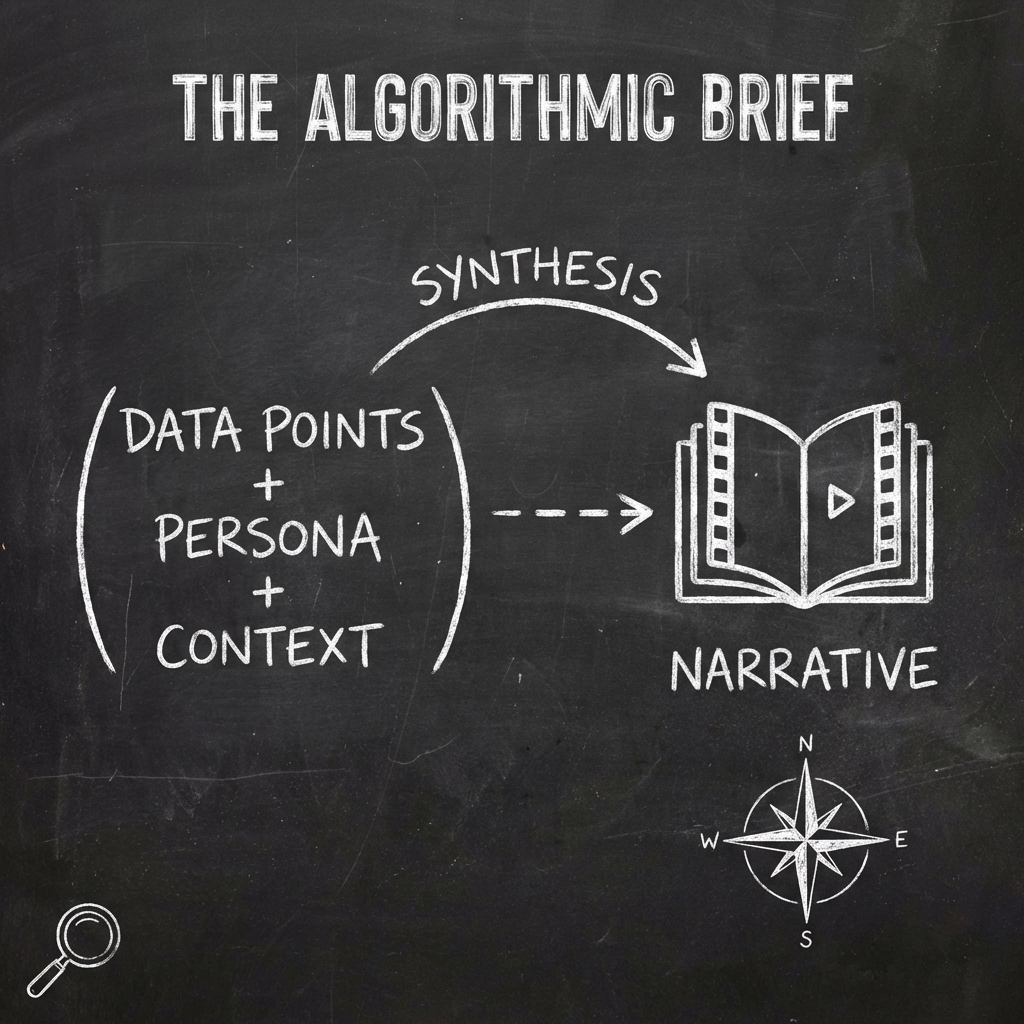
The system employs a specific “prompt pipeline” to synthesize the distinct clusters identified in the previous phase. The equation is simple but powerful:
Target Persona Cluster + Communication Theme Cluster = User Story
The system takes:
- The Persona (e.g., “Efficiency Enthusiasts” - derived from 206 distinct ads).
- The Theme (e.g., “Streamlining Work Transport” - derived from 336 distinct ads).
It then prompts an LLM to “amalgamate the characteristics” of these two mathematical clusters to devise a narrative for a fictitious character who embodies their intersection.
Case Study: “Samuel Tan”
In the research paper, the researchers applied this pipeline to the Gojek vs. Grab dataset. They selected Persona 1 (Efficiency Enthusiasts) and Challenge 3 (Streamlining Work Transport) as the inputs; a combination that the data showed was under-exploited by Gojek.
The LLM generated an avatar named “Samuel Tan”, a business owner in Singapore.
The Generated Narrative
This was not a generic, Hallucinated “Business Owner” persona. It was a specific narrative constructed from the semantic DNA of thousands of high-performing ads. The story described Samuel in vivid detail:
“Samuel runs a mid-sized logistics firm. He prioritizes business efficiency above all else, but he has a blind spot: he often neglects employee satisfaction. This has led to increased turnover rates in his fleet.”
Notice the conflict. The AI identified that “Efficiency” (Persona) and “Transport” (Theme) collide at the point of Turnover.
The narrative continues to the resolution:
“Recognizing this issue, Samuel opts for Gojek not merely as an efficiency solution, but as a means to re-engage with his employees. By offering them better ride options, he aims to improve overall job satisfaction.”
The Strategic Value
This is a massive leap from a spreadsheet. It tells the creative team exactly what the emotional arc of the campaign should be:
- The Villain: Staff Turnover / Employee Burnout.
- The Hero: Intelligent Transport (Gojek).
- The Value Prop: Retention through Convenience.
This narrative serves as a “Content Brief” that can be handed to a human agency or used as a seed for further AI generation.
Human-Level Parity
The researchers make a bold claim in their conclusion:
“In our professional opinion, content briefs produced by SOMONITOR are on par with similar human-written narratives and can be used just as effectively.”
This is the holy grail of automated marketing. The system did not just finding a pattern; it wrote a strategy.
The new workflow: The action engine
This changes the role of the modern marketer. You are no longer responsible for coming up with the “big idea” from scratch. You are the architect of a system that discovers the idea for you.
Your new workflow looks like this:
- Mine the Data: Use SODA to filter for high-CTR content (the scout).
- Cluster the Signals: Use X-Means to identify the Personas (the architect).
- Generate the Story: Use the Narrative Equation to write the Brief (the storyteller).
- Execute: Hand the brief to a human creative (or an AI) to write the final copy.
This is the action engine of modern marketing. It implies that creativity is not a magical lightning strike, but a discoverable resource that can be mined, refined, and scaled.
We are moving from an era of “creative guesswork” to “algorithmic certainty.” And as the “Samuel Tan” story proves, the algorithm might just know your customer better than you do.
My view: The algorithmic ceiling
The paper concludes that their AI briefs are “on par with human-written narratives.” I read this not as a victory, but as a warning.
Basing your creative brief entirely on a “High CTR” prediction model creates a Feedback Loop of Mediocrity. The model favors “Clickbait”; short-term attention hooks; over deep, resonant brand building.
“Samuel Tan” is a safe persona. He effectively addresses the “Turnover” pain point. But he lacks the spark; unexpected insight that comes from human empathy, not mathematical averaging.
The SOMONITOR framework is a correct tool for Mid-Funnel efficiency. It will churn out highly competent, high-converting performance ads at scale. But it cannot write the Top-Funnel Manifesto. It cannot dream.
Use this engine to manage your baseline, but do not let it replace your vision. The algorithm can find the door, but only a human can decide if it’s worth opening.
Share Article
If this article helped you, please share it with others!
Some content may be outdated