
 Melky
Melky 
Google's AI "Action Engine": Decoding the new architecture of search for SEOs

If you work in SEO or digital marketing, you’ve felt it. The ground has shifted in a way that feels more fundamental than any single “core update” or the introduction of AI Overviews.
It’s a systemic change in how search behaves, and more importantly, how it drives user behavior.
My post about RAG and LC broke down the individual technological pillars driving this change: understanding multifaceted intent (MUVERA), generating answers (the RAG/LC hybrid), and personalizing the experience (LaMP).
But looking at them in isolation misses the point. The true revolution lies in how these three systems converge to create something entirely new: an Architecture of Action. Understanding this two-brain dialogue is essential.
This article will connect those dots.
I will explore how Google moved beyond a simple search engine to become a sophisticated “action engine,” designed with a singular purpose: to understand a user’s goal with profound accuracy and radically shorten the path to its fulfillment.
This post synthesizes concepts from the “AI Search? It’s Just Search, Rebranded” series, showing how foundational patents power today’s AI-driven search.
Pillar 1: Deconstructing intent; The engine’s “What”
The foundation of this new architecture is Google’s ability to see a query not as a string of words, but as a bundle of intentions. This is the evolution from Multi-Aspect Retrieval to MUVERA.
What it is: A system that dissects a query into its component facets, intent type e.g:
-
eCommerce, informational
-
attributes (e.g., color, size),
-
and context (e.g., for a beginner, for a professional).
The Deeper Implication (The “What”): The primary goal is no longer to match keywords, but to identify the user’s desired end-state. Is the user trying to buy something, learn something, fix something, or go somewhere?
By identifying the verb behind the noun, the action behind the query, Google can instantly orient the entire search experience around facilitating that specific action.
This is the system’s “North Star.”
Pillar 2: The Answer Synthesis, The Engine’s “How”
Once Google understands what the user wants to do, it must determine how to best provide the information that enables them to do it.
This is the role of the hybrid RAG/LC model, which we’ve called “Self-Route.”
What it is: A two-step system that first tries to find a quick, efficient answer from retrieved snippets (RAG), and if the query is too complex, escalates to a deep synthesis of multiple full documents (LC).
The Deeper Implication (The “How”): This system is designed to manufacture confidence and remove friction. An AI Overview is not just a summary; it’s a pre-packaged decision-making tool.
By synthesizing reviews, comparing features, and summarizing pros and cons, Google performs the cognitive heavy lifting that the user would have previously done by opening ten different tabs.
This manufactured confidence is the critical catalyst that empowers a user to move from a state of consideration to a state of action.
Pillar 3: The Personalization Layer, The Engine’s “For Whom”
This is the final, and most powerful, layer.
With insights from research like the LaMP benchmark, Google completes the circuit. It knows what the user wants to do and how to convince them, but now it can tailor the delivery to whom it’s serving.
What it is: A system that uses a “user profile”, built from their past searches, clicks, brand affinities, and even writing style, to inform and customize the final output.
The Deeper Implication (The “For Whom”): This is the “last mile” of relevance. It makes the path to action feel effortless and natural for the individual. If the system knows you prefer deep-dive video reviews, it might surface a YouTube link.
If it knows you’re a loyal Amazon Prime customer, it might prioritize a direct product link. It eliminates the guesswork in finding the perfect path to conversion by using the user’s own history as the map.
It’s the ultimate solution to implicit intent, because your personal context makes your intent explicit to the engine.
The Synthesis: Google’s Integrated Action Funnel
When you combine these three pillars, you see the true architecture emerge. Google has effectively built its own high-efficiency, personalized marketing and sales funnel directly into the SERP.
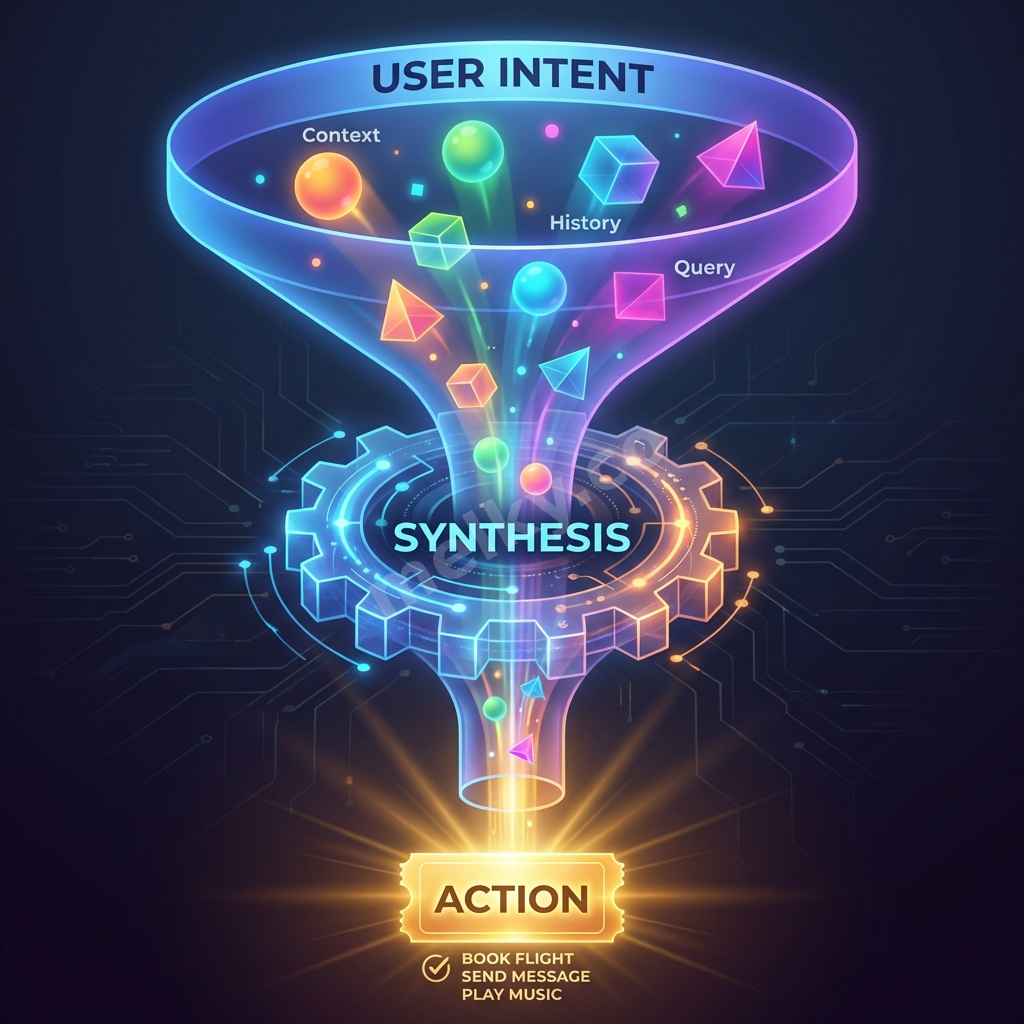
Top of Funnel (Awareness/Intent): The Multi-Aspect system captures the user’s raw intent with incredible precision, instantly categorizing their need.
Middle of Funnel (Consideration/Confidence): The RAG/LC Hybrid synthesizes information to answer their complex questions, removing doubt and building the confidence needed to make a decision.
Bottom of Funnel (Conversion/Action): The Personalization Layer presents the final, tailored call-to-action or link that is most likely to resonate with that specific user, giving them the final nudge to convert.
This is why the changes feel so profound.
Google is no longer just sending traffic to your funnel; it is now an active participant, guiding users through its own integrated funnel and delivering them to your digital doorstep, primed for action.
Conclusion
Surviving and thriving in this new ecosystem requires a strategic shift away from tactical SEO and towards a more holistic, user-centric approach.
Your content strategy must be built around answering the “what” and the “why” behind a query. Create clusters of content that address every facet of a user’s potential goal, from initial research to final purchase justification.
Your job is to make Google’s synthesis job easy. Produce content that is well-structured, connects the dots, compares and contrasts, and answers implicit questions. This makes your page a prime candidate for being featured in an AI Overview that builds user confidence.
The personalization engine rewards specificity. The more clearly your content speaks to a defined user persona, the more likely the engine is to match your content with a user who fits that profile.
User engagement signals, dwell time, bounce rate, and repeat visits are the raw data that feeds the personalization engine. Your goal is not to win a single click, but to win the user’s trust.
The ultimate SEO strategy is to become a user’s preferred, reliable partner in their journey, because Google is now actively looking for and rewarding exactly that.
Source: LaMP: When Large Language Models Meet Personalization
Share Article
If this article helped you, please share it with others!
Some content may be outdated